Choosing the right development partner is a make‑or‑break decision for any high‑growth organization. A well‑crafted dev partner evaluation checklist helps you cut through glossy pitches, align expectations, and lock in outcomes that scale with your business. Below is a practical, eight‑step framework that founders, product leaders, and ops managers can apply immediately.
Why a Structured Evaluation Matters for High‑Growth Teams
High‑growth teams operate under tight timelines, limited bandwidth, and relentless pressure to deliver revenue‑impacting features. A structured evaluation eliminates guesswork, ensuring that every vendor is measured against the same criteria. This reduces the risk of hidden technical debt, scope creep, and misaligned incentives that can stall momentum. Moreover, a repeatable process builds institutional knowledge—future hiring or expansion decisions become faster because you already know which signals matter. In short, a disciplined approach translates directly into faster time‑to‑market and more predictable budgeting, two non‑negotiables for scaling companies.
Step 1 – Define Success Metrics and Project Scope Up Front
Before you even open a RFP, articulate what success looks like. Identify key performance indicators (KPIs) such as feature delivery cadence, defect rate, user adoption targets, and ROI timelines. Pair these metrics with a crystal‑clear project scope: user stories, integration points, and data migration requirements. By quantifying expectations early, you create a baseline against which every partner can be judged. This also forces internal stakeholders to prioritize must‑have versus nice‑to‑have features, preventing scope bloat later. Remember, the clearer the success criteria, the easier it is to hold a partner accountable throughout the engagement.
Step 2 – Assess Technical Competence and Stack Alignment (dev partner evaluation checklist)
Technical fit is non‑negotiable. Verify that the partner’s core expertise aligns with your stack—whether it’s full‑stack Next.js/React, serverless architectures, or AI‑driven automation. Ask for concrete examples of similar challenges they’ve solved, and request a short technical quiz or live coding session to gauge depth. Look for evidence of modern practices: component‑driven development, automated testing pipelines, and CI/CD maturity. A partner that can speak the same language reduces friction, accelerates onboarding, and ensures that future extensions remain on a solid foundation.
Step 3 – Review Portfolio, References, and Real‑World Outcomes
A glossy portfolio is only the first layer. Dig deeper into case studies that showcase measurable outcomes—reduced load times, increased conversion rates, or cost savings from automation. Reach out to at least two references who can speak to delivery speed, communication quality, and post‑launch support. Pay attention to industry relevance; a partner who has built B2B customer portals for SaaS firms will understand the nuances of multi‑tenant security and data isolation. For a deeper dive into post‑launch expectations, see our post‑launch support service page.
Step 4 – Vet Process Rigor: Agile cadence, documentation, and QA
Scrutinize the partner’s development process. Do they run two‑week sprints with clear sprint goals and retrospectives? How do they capture requirements—user stories, acceptance criteria, or informal tickets? Robust documentation (architecture diagrams, API contracts) is a sign of long‑term maintainability. Equally important is their QA strategy: unit tests, integration tests, and automated regression suites. A partner that embeds quality into the workflow reduces surprise bugs and supports faster releases. If you’re dealing with regulated data, see our SOC 2 Readiness for SaaS: A Founder’s Practical Roadmap for additional compliance considerations.
Step 5 – Compare Pricing Models and Hidden Cost Triggers
Pricing transparency prevents budget overruns. Compare fixed‑price, time‑and‑materials, and outcome‑based models against your risk tolerance. Identify hidden cost triggers such as change‑request fees, third‑party licensing, or infrastructure provisioning. Ask for a detailed cost breakdown for each phase—discovery, MVP, scaling, and maintenance. Remember that the cheapest quote may hide gaps in expertise that later manifest as rework. Align the pricing model with the success metrics you defined in Step 1 to ensure incentives are mutually reinforcing.
Step 6 – Examine Governance, Security, and Compliance Practices
Governance frameworks dictate how decisions are made and risks are mitigated. Verify that the partner follows industry‑standard security practices—regular penetration testing, encrypted data at rest and in transit, and role‑based access controls. For SaaS products handling EU data, GDPR compliance is mandatory; for US‑based financial services, SOC 2 or ISO 27001 may be required. Ask for their incident‑response plan and how they handle data residency requirements. Our guide on hiring a dev partner outlines the governance checklist you should expect.
Step 7 – Conduct a Pilot or Proof‑of‑Concept Sprint
Before committing to a multi‑year contract, run a short, bounded pilot. Define a concrete deliverable—perhaps a core workflow or an API integration—aligned with your success metrics. Use this sprint to evaluate communication cadence, code quality, and delivery speed. The pilot also surfaces any cultural mismatches early, allowing you to adjust expectations or walk away before significant resources are sunk. Treat the pilot as a live experiment; the data you collect will be the most persuasive evidence when you make the final decision.
Conclusion – Turn the Checklist into a Decision Framework
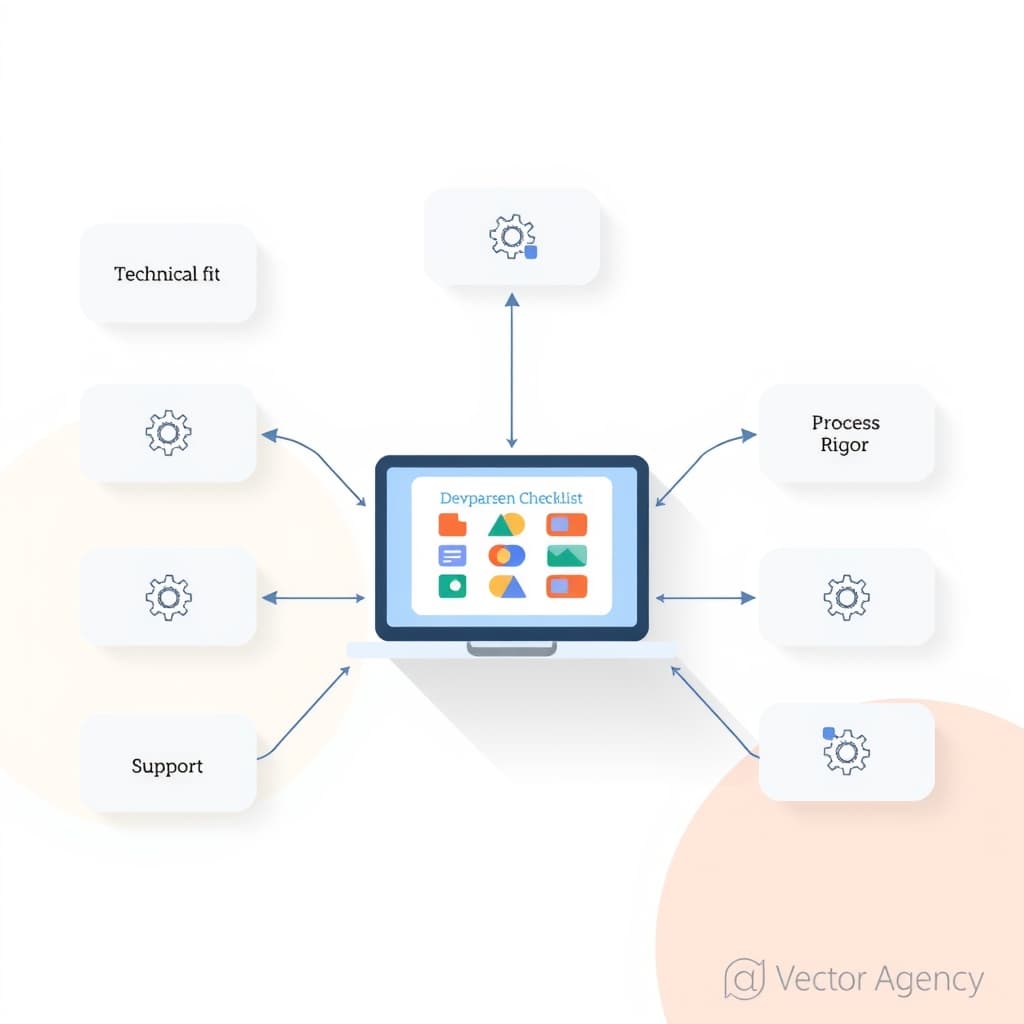
By converting the eight‑step dev partner evaluation checklist into a weighted decision matrix, you can objectively compare candidates and surface the best fit for your growth trajectory. Capture scores for each criterion, apply your strategic weightings, and let the numbers guide the conversation with stakeholders. Ready to streamline your evaluation? Download our free evaluation template and book a call with SiteFusion to see how we can turn your vision into a production‑ready product.