Getting a SOC 2 audit can feel like a massive project, but a well‑structured SOC 2 checklist for founders turns it into a series of manageable steps. Whether you’re raising a Series A round or onboarding enterprise customers, the audit demonstrates that you treat data security, availability, and privacy with the same rigor you apply to product development. Below is a practical, step‑by‑step guide that aligns with the audit’s expectations while keeping engineering velocity intact.
Why SOC 2 matters for early‑stage SaaS – a SOC 2 checklist for founders
Early‑stage SaaS companies often think compliance is a later‑stage concern, yet investors and enterprise buyers increasingly require SOC 2 reports before signing contracts. The certification reduces sales friction, shortens legal review cycles, and provides a competitive moat by proving you have systematic controls rather than ad‑hoc fixes. Moreover, the audit surfaces gaps in your security posture that, if left unchecked, could lead to costly breaches. By integrating SOC 2 preparation into your product roadmap, you align security with feature delivery, turning compliance into a growth lever rather than a blocker.
Understanding the five Trust Service Criteria
SOC 2 evaluates controls against five Trust Service Criteria (TSC): Security, Availability, Processing Integrity, Confidentiality, and Privacy. Security is the baseline—protecting against unauthorized access. Availability ensures your service remains reachable as defined in SLAs. Processing Integrity checks that data is processed accurately and completely. Confidentiality covers encryption and access restrictions for sensitive information, while Privacy focuses on personal data handling in line with regulations like GDPR. Not every SaaS needs to certify all five; most start with Security, Availability, and Confidentiality, then expand as customer contracts demand. Understanding which criteria apply to your product shapes the scope of your checklist and prevents unnecessary work.
Step 1 – Define Scope and Identify In‑Scope Systems
The first practical task is to draw clear boundaries around what the audit will cover. List every application, database, and third‑party service that stores, processes, or transmits customer data. Include supporting infrastructure—load balancers, CI/CD pipelines, and monitoring tools—because auditors will probe how they interact with the core system. Keep the scope tight enough to be manageable but broad enough to satisfy customer expectations. Document the rationale for each inclusion; this becomes part of the evidence package later. If you’re unsure whether a microservice belongs in scope, ask whether it handles any data that appears on a customer contract or SLA.
Step 2 – Map Data Flows and Apply Least‑Privilege Controls
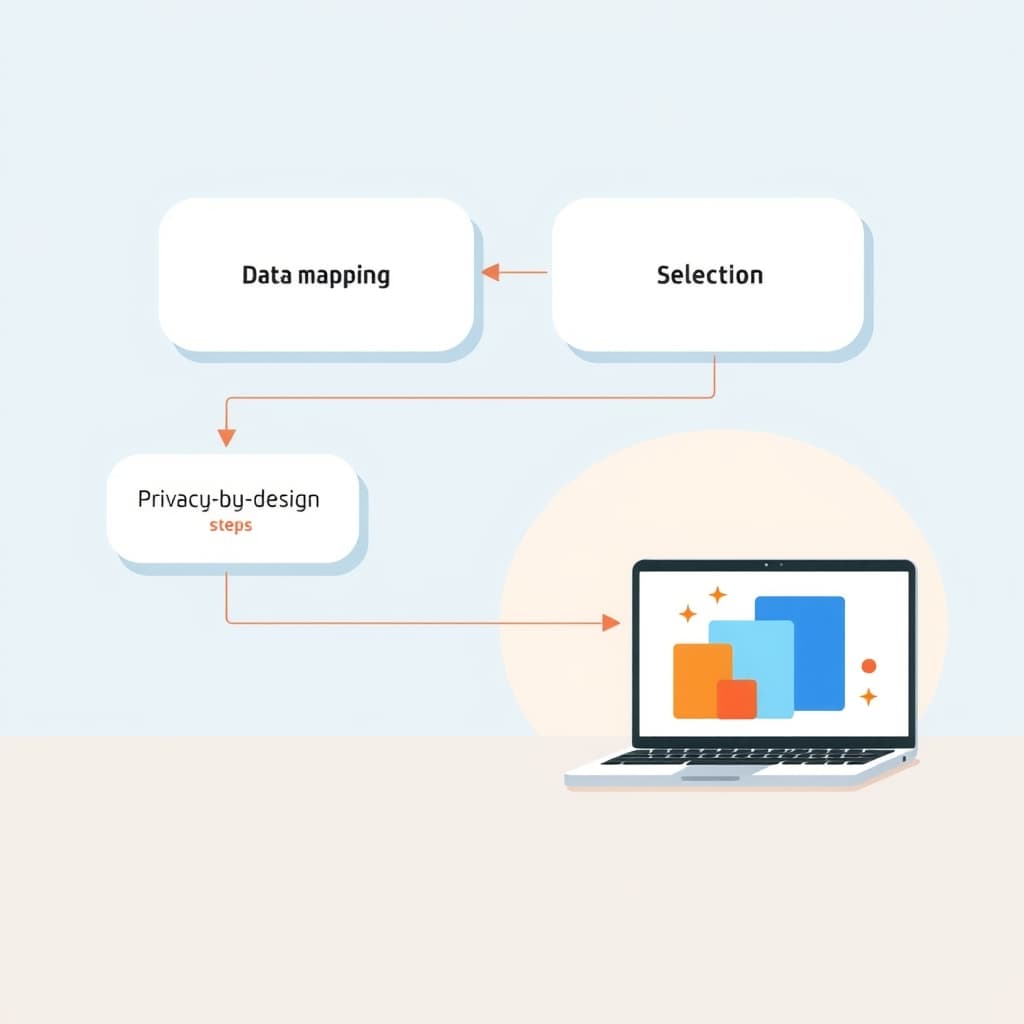
With the in‑scope systems identified, create a visual data‑flow diagram that shows how data moves from ingestion to storage, processing, and export. Highlight points where data is transformed, encrypted, or handed off to third parties. This map is the backbone for applying least‑privilege principles: every service account, API key, and user role should have only the permissions required for its specific function. Review IAM policies, secret management, and token lifetimes. For complex integrations, consider the Hybrid Webhook Batch Pattern for Reliable Data Sync as a way to enforce strict access controls while maintaining performance.
Step 3 – Implement Core Security Controls (Access, Encryption, Monitoring)
Now translate the data‑flow insights into concrete controls. Enforce multi‑factor authentication for all privileged accounts and use role‑based access control (RBAC) to limit admin rights. Encrypt data at rest with AES‑256 and enforce TLS 1.2+ for data in transit. Deploy centralized logging and real‑time monitoring—tools like Elastic Stack or Splunk can aggregate logs from all in‑scope components. Set up alerting for anomalous login attempts, privilege escalations, and unexpected data exfiltration patterns. These controls satisfy the Security and Confidentiality criteria and provide the evidence auditors will request.
Step 4 – Prepare Evidence and Documentation for Auditors
Auditors need tangible proof that controls exist and operate effectively. Compile policies (e.g., password policy, incident‑response plan), configuration screenshots, and access‑review logs. Maintain a change‑management log that records who approved, implemented, and tested each security change. Store all artifacts in a secure, auditable repository—Git, Confluence, or a dedicated compliance portal. Create a “control matrix” that maps each TSC requirement to the specific evidence you’ve gathered. This matrix becomes the roadmap auditors follow, reducing back‑and‑forth requests and keeping the audit timeline predictable.
Step 5 – Run a Pre‑Audit Self‑Assessment and Fix Gaps
Before inviting the external auditor, conduct an internal walk‑through using the same control matrix. Assign owners to each control and have them verify that the documented evidence matches reality. Use automated scanners for vulnerability assessment and configuration drift detection. Any gaps—missing logs, outdated encryption keys, or undocumented processes—should be remediated now. This “dry run” often uncovers low‑effort fixes that prevent major findings later. If you need additional expertise, consider leveraging our post‑launch support to fine‑tune monitoring or incident‑response procedures.
Step 6 – Run a Pre‑Audit Self‑Assessment and Fix Gaps
After the dry run, schedule a formal pre‑audit with a qualified CPA firm that specializes in SOC 2. They will perform a limited scope review, providing a “read‑only” opinion on your readiness. Treat their feedback as a final checklist; address any remaining deficiencies promptly. This step also gives you a realistic sense of the time and resources required for the full audit, allowing you to adjust sprint planning and budget allocations accordingly.
Next steps: Maintaining compliance and leveraging SOC 2 as a growth asset
Achieving SOC 2 is not a one‑time event. Establish a continuous compliance program that incorporates regular access reviews, quarterly control testing, and annual refresher training for staff. Automate evidence collection where possible—use CI pipelines to capture configuration snapshots and integrate log‑aggregation into your deployment dashboards. Over time, the SOC 2 report becomes a sales enablement tool: embed the certification badge on your website, reference it in RFP responses, and use it to negotiate better contract terms. As your product scales, the same controls that earned the audit will support higher traffic, more data, and broader geographic reach.
Ready to turn compliance into a competitive advantage? Book a call with SiteFusion and let our senior engineers help you embed SOC 2 into your product roadmap from day one.