Launching a product without a clear MVP scoping framework is like building a house on sand – you’ll waste time, money, and credibility before you even have a roof. Early‑stage founders need a repeatable process that translates market insight into a concrete set of deliverables, and that process starts with disciplined scoping. Below is a step‑by‑step guide that lets you decide what to build first, keep stakeholders aligned, and hand off a crisp brief to any development partner.
Why a Structured MVP Scoping Framework Beats Guesswork
Guesswork relies on intuition, which is valuable but unreliable at scale. A structured MVP scoping framework forces you to surface assumptions, quantify risk, and align the team around a single definition of “minimum”. By documenting user journeys, success metrics, and trade‑offs, you create a decision surface that can be reviewed, critiqued, and iterated. This reduces the classic “feature creep” that drains runway and erodes focus. Moreover, a repeatable framework builds institutional memory – the next product iteration starts from a proven baseline rather than a fresh set of guesses. In practice, teams that adopt a formal scoping process see faster validation cycles and clearer handoffs to engineering or external agencies.
Defining Success: The One Metric That Must Move
Before you write a single line of code, agree on the single metric that will prove your MVP’s viability. This could be “qualified leads per week,” “transactions per day,” or “time saved per user.” The key is that the metric is both leading (it signals future growth) and measurable with existing tools. Once identified, every feature you consider must either directly influence that metric or be neutral. This focus prevents vanity features that look impressive but don’t move the needle. Aligning the team around one success metric also simplifies communication with investors and partners – they can see a clear, data‑driven path to product‑market fit.
Step 1 – Map Core User Journeys and Identify the Minimal Value Loop
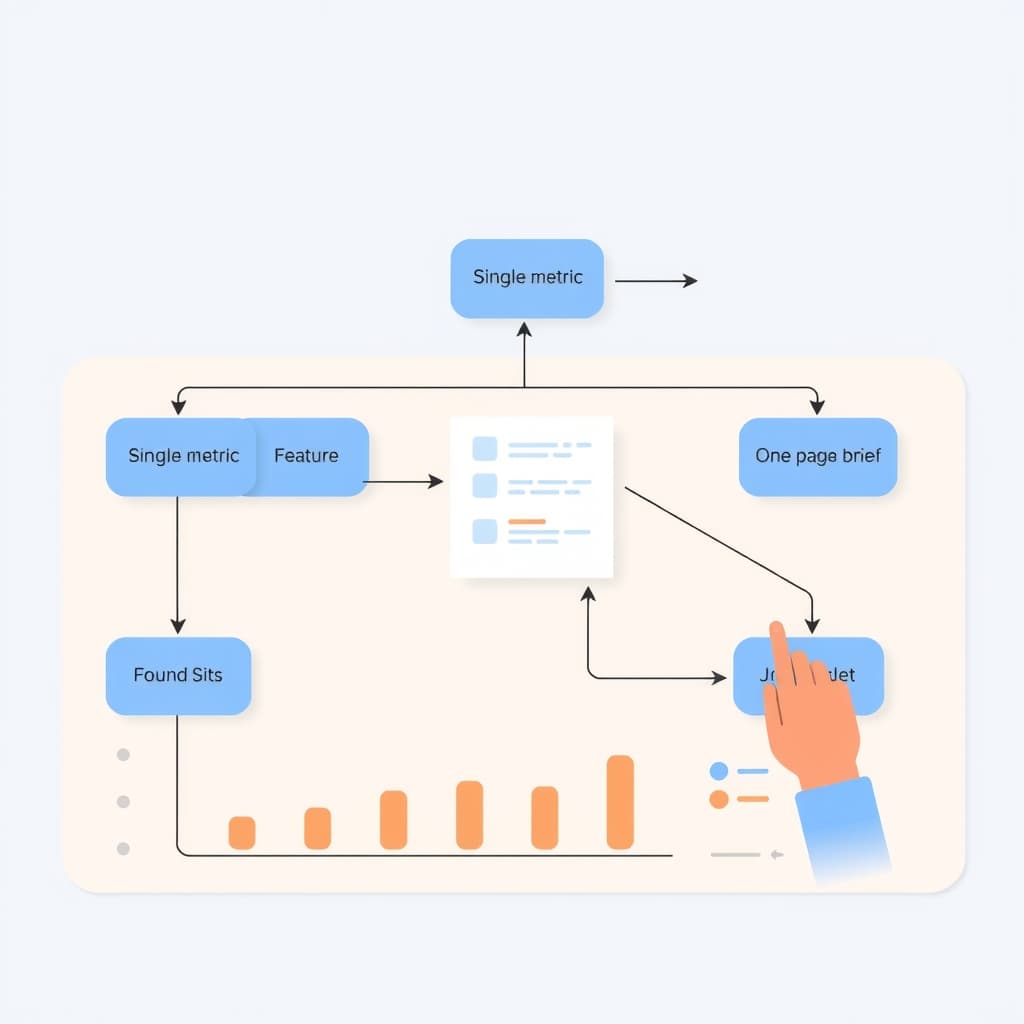
Start by sketching the end‑to‑end experience for your primary persona. Break the journey into discrete steps: discovery, onboarding, core action, and feedback. Then ask, “What is the smallest loop that delivers real value to the user and moves our success metric?” The minimal value loop often strips away ancillary steps and isolates the core interaction that solves the user’s problem. Document this loop in a simple flow diagram or bullet list, and flag any steps that are optional or can be deferred. This exercise surfaces the essential data flows and integration points, which later informs both the ICE matrix and the one‑page brief. For multi‑tenant SaaS ideas, see our Multi‑tenant SaaS Billing Architecture guide for early‑stage considerations.
Step 2 – Prioritize Features with the ICE (Impact, Confidence, Effort) Matrix
Populate a three‑column table for each candidate feature: estimated impact on the success metric, confidence in your assumptions, and effort (person‑weeks). Assign a score of 1‑10 for each axis, then calculate a simple ICE score (Impact × Confidence ÷ Effort). Features with high impact, high confidence, and low effort rise to the top. This quantitative approach removes personal bias and highlights quick wins. Remember to revisit scores after any new research – confidence can shift dramatically after a prototype test. The ICE matrix also serves as a communication tool for investors who want to see a data‑backed prioritization process.
Step 3 – Translate Priorities into a One‑Page Brief Ready for Agencies
Condense the top‑ranked features into a single‑page brief that includes: the core user journey, the minimal value loop, the success metric, and the ICE‑ranked feature list with brief descriptions. Add acceptance criteria for each feature – what does “done” look like? Include any non‑functional requirements such as security (SOC 2) or performance targets. This brief becomes the contract between you and any external development partner, ensuring everyone starts from the same baseline. A well‑crafted brief also reduces the need for endless clarification meetings, accelerating the kickoff phase. For agencies unfamiliar with your domain, link to your portfolio at our portfolio of products so they can see relevant experience.
Step 4 – Validate Assumptions with Low‑Cost Experiments Before Coding
Before any line of production code is written, run the cheapest possible test of each high‑impact assumption. This could be a landing‑page click‑through, a manual wizard, or a paper prototype. Track the same success metric you defined earlier. If the experiment moves the needle, you have validation; if not, you either pivot the assumption or drop the feature. These experiments cost a fraction of full development and provide real user feedback that can be fed back into the ICE scores. The approach mirrors the “fail fast” principle and aligns with our AI Feature Cost Control philosophy of maintaining quality while minimizing spend.
Step 5 – Guard Against Scope Creep: Decision Gates and Release Criteria
Establish clear decision gates at the end of each development sprint. The gate criteria should reference the success metric, acceptance tests, and any regulatory or security checkpoints (e.g., SOC 2 readiness). If a feature fails to meet its gate, it is either re‑scoped or removed from the MVP. Document these gates in a simple checklist and share it with the entire team. Decision gates act as a safety net, preventing the natural tendency to add “nice‑to‑have” items once momentum builds. For founders wrestling with build‑vs‑buy decisions, our When to Build vs Buy SaaS post provides a complementary decision matrix.
Step 6 – Build a Roadmap That Balances Speed, Quality, and Future Scaling
With the MVP defined, map out a short‑term roadmap that sequences releases by value and technical dependency. Include milestones for core functionality, performance optimization, and post‑launch monitoring. Allocate buffer time for post‑launch support, because early bugs can erode user trust and the success metric you’ve chosen. Also flag features that are “deferred but architecturally ready” – they can be turned on with minimal code changes as the product scales. This roadmap should be a living document, updated after each validation experiment and after each release gate, ensuring that speed never compromises quality or future scalability.
Conclusion & CTA – Apply the Framework with SiteFusion’s Free Scoping Audit
By following this practical MVP scoping framework, you turn vague ideas into a laser‑focused product plan that can be handed off to any development team with confidence. The result is faster validation, lower spend, and a clear path to market‑fit. Ready to put the framework to work on your next product? Book a free scoping audit with SiteFusion today and let our senior engineers translate your brief into a launch‑ready MVP. Schedule your call now.