When a SaaS product stitches together dozens of third‑party services, the API integration reliability checklist becomes the backbone of a smooth user experience. A single broken call can cascade into data loss, billing errors, or churn‑inducing downtime. This post walks growth‑stage founders, ops leads, and product managers through the practical steps that keep integrations dependable at scale.
Why Reliability Matters: The Cost of Broken Integrations
Every failed request is a lost transaction, a frustrated user, and a ticket for support. In a subscription model, even a few minutes of outage can translate into measurable revenue impact because customers expect real‑time data sync. Beyond direct financial loss, broken integrations erode trust, making future partnership negotiations harder. Teams that treat reliability as a feature, not an afterthought, see lower support costs and higher Net Promoter Scores. The cost of remediation—debugging, hot‑fixes, and emergency patches—also diverts engineering bandwidth from product innovation. By embedding reliability into the integration lifecycle, you protect both the bottom line and the brand reputation.
Core Principles of a Robust API Integration Strategy
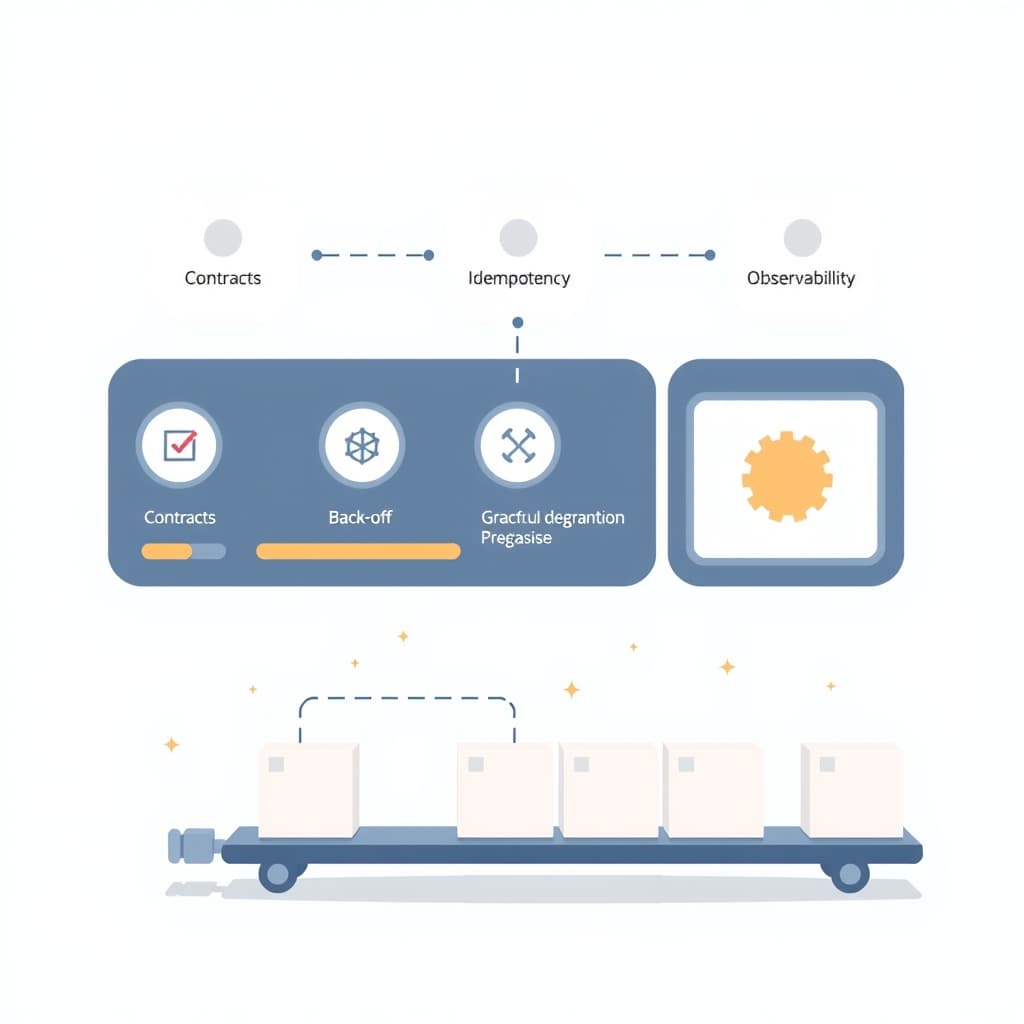
A solid strategy rests on four pillars: clear contracts, defensive coding, observability, and graceful degradation. First, define explicit request/response schemas and version them; this prevents silent breakage when a provider changes fields. Second, code defensively by validating inputs and handling unexpected status codes. Third, instrument every hop with metrics and logs so you can spot latency spikes before they affect users. Finally, design fallback paths—cached responses, queuing, or read‑only modes—to keep the core product functional during upstream hiccups. For a deeper dive into post‑launch reliability, see our Essential Post‑Launch Reliability Checklist. Applying these principles early reduces technical debt and makes scaling smoother.
Designing Idempotent Endpoints to Prevent Duplicate Data
Idempotency guarantees that repeating the same request yields the same result, a critical safeguard when retries are automatic. Implement a unique request identifier (e.g., a UUID) that the server stores alongside the operation outcome. On receipt of a duplicate identifier, the endpoint returns the original response without re‑executing the action. This pattern eliminates double‑charges, duplicate records, and race conditions in eventual‑consistency flows. For write‑heavy integrations, expose bulk endpoints that accept arrays of items with client‑generated keys, allowing the server to deduplicate efficiently. Document the idempotency key requirement in your API contract so downstream developers know how to use it correctly.
Implementing Retries, Back‑off, and Circuit Breakers
Transient failures—network glitches, rate limits, or temporary service degradation—are inevitable. A retry policy with exponential back‑off reduces load on the failing service while giving it time to recover. Limit retries to a sensible count (typically 3‑5) and cap the maximum delay to avoid excessive latency. Pair retries with a circuit breaker that opens after a threshold of consecutive failures, routing calls to a fallback or returning a controlled error. While the circuit is open, a cool‑down timer gradually allows traffic to resume, preventing thundering‑herd effects. Implement these patterns at the HTTP client layer so they apply uniformly across all integrations.
Monitoring, Alerting, and Observability for API Flows
Visibility starts with structured logging: include request IDs, endpoint names, latency, and status codes in each log line. Export these logs to a centralized platform and correlate them with metrics such as error rate, p99 latency, and retry count. Set alerts on thresholds that matter to your SLA—e.g., error rate > 1% over five minutes or latency spikes beyond 2 seconds. Use distributed tracing to follow a request across service boundaries, revealing where bottlenecks form. Dashboards that surface per‑partner health help ops teams prioritize outreach before customers notice issues.
Testing Strategies: Contract, Chaos, and End‑to‑End Tests
Automated contract tests validate that both sides honor the agreed schema. Tools like Pact or OpenAPI validators generate tests from the contract, catching breaking changes early. Chaos testing—injecting latency, timeouts, or HTTP 5xx responses—verifies that retry, back‑off, and circuit‑breaker logic behave as intended under stress. Complement these with end‑to‑end integration tests that exercise real provider sandboxes, ensuring data flows correctly from ingestion to persistence. Schedule these suites in CI pipelines so regressions are caught before code lands in production.
Handling Third‑Party Outages Gracefully
When a provider goes down, the user experience should degrade predictably, not catastrophically. Implement a status cache that records the last known health of each external API, refreshed on a regular schedule. If the cache indicates an outage, route calls to a stale‑data fallback or a read‑only mode, and surface a clear UI message explaining limited functionality. Queue outbound actions for later processing rather than failing immediately; this preserves intent and reduces data loss. Communicate proactively with customers through status pages or in‑app banners, turning a technical incident into a managed experience.
Documentation and Versioning Best Practices
Comprehensive, versioned documentation is the first line of defense against integration drift. Publish OpenAPI specifications and keep them in sync with code through automated generation. Adopt semantic versioning for your API contracts: major changes break compatibility, minor updates add fields, and patches fix bugs. Deprecate old versions with clear timelines, and provide migration guides that include sample payloads and error‑handling patterns. Encourage partners to subscribe to change notifications via a webhook or RSS feed so they can adjust before a breaking change lands.
Putting It All Together: Your API Integration Reliability Checklist
Use this concise checklist to audit any new or existing integration:
- Define and version a contract; publish OpenAPI specs.
- Require idempotency keys for all mutating calls.
- Implement exponential back‑off with a capped retry count.
- Deploy circuit breakers with sensible failure thresholds.
- Instrument logs, metrics, and traces for every request.
- Set alerts on error rate, latency, and retry spikes.
- Run contract, chaos, and end‑to‑end tests in CI.
- Maintain a health cache and graceful fallback paths.
- Provide clear deprecation timelines and migration docs.
Running through this list before launch, and revisiting it quarterly, turns reliability from a hope into a habit.
Reliability is a competitive advantage for SaaS teams that need to move fast without sacrificing trust. If you want expert hands to embed these practices into your product roadmap, explore our post‑launch support services or book a strategy call today. Contact SiteFusion to start building rock‑solid integrations that scale.