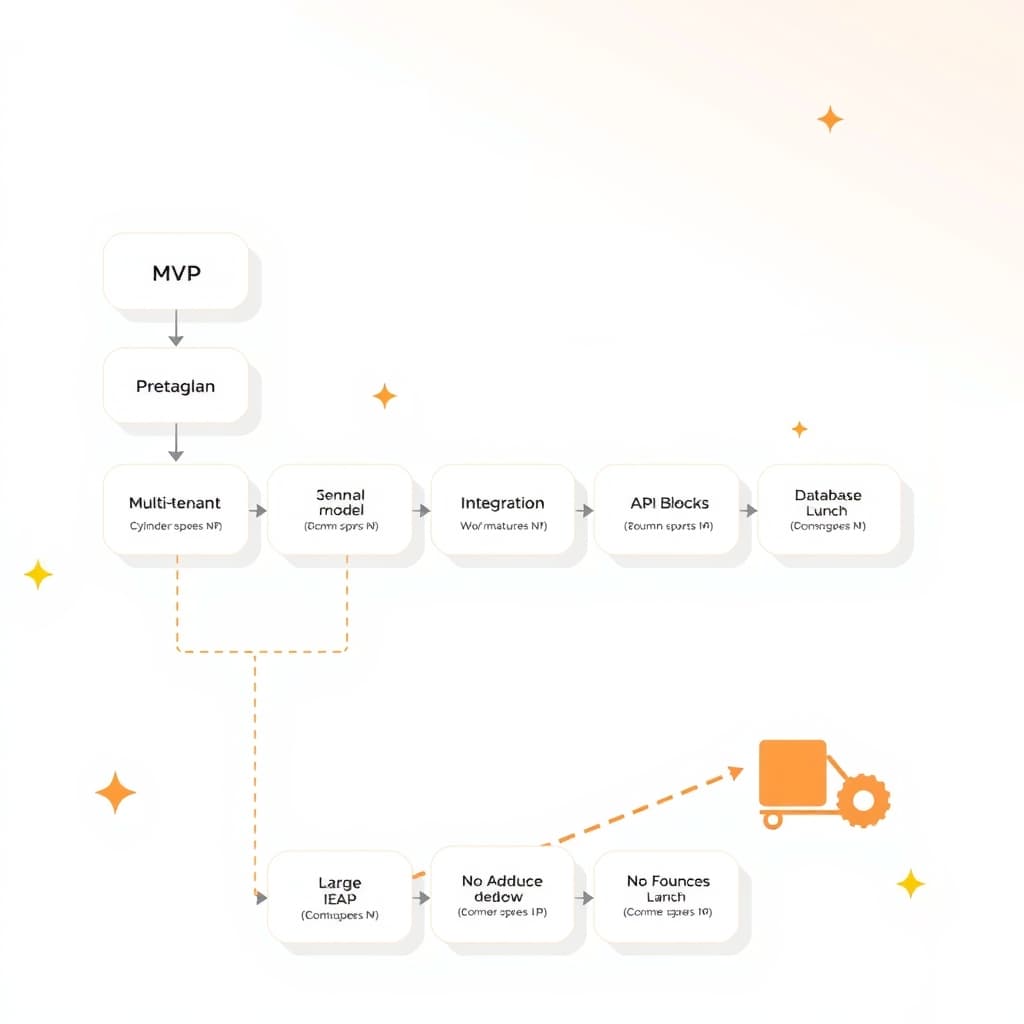
Creating a B2B customer portal roadmap is the difference between a product that scales with confidence and a patchwork of features that crumble under load. In this guide we walk founders, product leaders, ops managers and PMs through every phase—from the lean MVP to a production‑ready, secure launch—so you can move fast without sacrificing quality.
Why a Structured Portal Roadmap Beats Ad‑Hoc Feature Additions
Ad‑hoc development feels agile, but it quickly erodes architectural integrity. A structured roadmap forces you to prioritize business outcomes, align stakeholders, and allocate engineering bandwidth to the right problems. By mapping dependencies early—such as authentication, data tenancy, and integration points—you avoid costly refactors later. Moreover, a roadmap creates a shared language between product, ops, and engineering, turning vague “nice‑to‑have” ideas into concrete, testable milestones. This discipline reduces technical debt, improves predictability, and keeps the team focused on delivering measurable value rather than chasing feature parity with competitors.
Defining the Core MVP: The Minimum Viable Customer Experience
The MVP for a B2B portal isn’t a stripped‑down demo; it’s the smallest set of capabilities that delivers a real, repeatable business outcome. Start by identifying the primary workflow—order placement, invoice review, or support ticketing—and build only the screens, data models, and integrations needed to complete that loop. Validate this scope against the MVP Scope Validation Checklist: 7 Steps to Secure Funding to ensure you’re solving a pain point that justifies investment. Keep the UI intuitive, the data model lean, and the permission model simple. Early user testing should focus on task completion time and error rates, not on aesthetic polish. By delivering a functional end‑to‑end experience, you generate real usage data that will inform the next set of features on the roadmap.
Designing for Scalability: Multi‑Tenant Architecture & Permission Models
Growth‑stage B2B portals must serve dozens to hundreds of organizations without a performance cliff. Adopt a multi‑tenant architecture that isolates each client’s data at the schema or row level, depending on compliance requirements. Leverage tenant‑aware services in Next.js and React to keep code paths shared while allowing per‑tenant configuration. Permission models should follow the principle of least privilege; define roles (admin, manager, viewer) and map them to granular actions rather than broad sections. This approach simplifies future feature toggles and supports regulatory audits. Documentation of the tenancy strategy early on prevents the “single‑tenant‑to‑multi‑tenant” migration nightmare that many startups face.
Integrating Key Business Systems: Payments, CRM, and Data Sync
A portal that lives in a vacuum adds little value. Identify the three systems that drive revenue and customer success—typically a payment gateway, a CRM, and an ERP or data warehouse. Use robust, idempotent APIs to push and pull data, and employ a message queue or change‑data‑capture layer for near‑real‑time sync. The Building resilient API integrations for growth‑stage SaaS post outlines patterns for retry logic and circuit breaking that keep the portal functional even when a downstream service degrades. Secure each integration with OAuth or mutual TLS, and store credentials in a secret manager. By treating integrations as first‑class components, you avoid the “integration debt” that stalls scaling efforts.
Balancing Self‑Service vs. Human Touch: Reducing Support Load
Customers expect to resolve routine tasks—password resets, invoice downloads, usage reports—without opening a ticket. Implement self‑service flows backed by clear UI cues and contextual help. For complex issues, embed a live chat or schedule‑a‑call widget that routes directly to the appropriate support tier. Track the deflection rate (self‑service completions vs. support tickets) to gauge effectiveness. When the deflection threshold drops, revisit the knowledge base or add guided workflows. This balance not only cuts support costs but also improves the overall customer experience, turning the portal into a trusted, 24/7 service channel.
Measuring Success Early: Metrics, Feedback Loops and Iteration Cadence
Success isn’t a gut feeling; it’s a set of leading indicators you monitor from day one. Core metrics include activation rate (first login to first meaningful action), task completion time, and churn risk signals such as login frequency drop. Implement in‑app feedback widgets to capture qualitative insights alongside quantitative data. Establish a two‑week iteration cadence: review metrics, prioritize bugs or enhancements, and ship a small, tested increment. This rapid loop keeps the product aligned with user needs and provides the data needed to justify further investment to stakeholders.
Launching the Portal: Staged Rollout, Onboarding Playbook and Change Management
A full‑scale launch is risky; a staged rollout mitigates that risk. Begin with an internal beta, then a pilot group of 5‑10 customers who represent different segments. Use feature flags to enable or disable components per tenant, allowing you to gather performance data and user feedback without exposing unfinished functionality. Parallel to the technical rollout, deliver an onboarding playbook that covers account setup, data migration, and training webinars. Align change management with the customer’s internal processes—share release notes, set expectations for support windows, and provide a clear escalation path. This coordinated approach reduces friction and builds confidence among early adopters.
Post‑Launch Playbook: Continuous Improvement, Security Hardenings and Growth Hacks
Launching is not the end; it’s the beginning of a continuous improvement cycle. Schedule regular security reviews—penetration testing, least‑privilege audits (Least Privilege Authentication: Secure SaaS Guide for Founders), and dependency updates. Use the post‑launch support service to monitor uptime, performance, and incident response. Growth hacks such as in‑portal upsell banners, referral incentives, and usage‑based pricing experiments can be A/B tested without redeploying core code. Keep a backlog of low‑effort enhancements that deliver high ROI, and revisit the roadmap quarterly to align with evolving business goals.
Conclusion & Next Steps: How SiteFusion Can Accelerate Your Portal Journey
Building a B2B customer portal that scales requires disciplined planning, a solid technical foundation, and relentless measurement. The roadmap outlined above gives you a proven framework to move from MVP to a secure, high‑performing launch. SiteFusion’s expertise in full‑stack Next.js/React development, multi‑tenant design, and API integration can shorten your timeline and reduce risk. Explore our what we build page for detailed capabilities, or view our portfolio of products to see similar portals in action. Ready to turn this roadmap into reality? Book a call with our team today.
For the complete picture, read our guide to B2B Web Apps & Customer Portals.