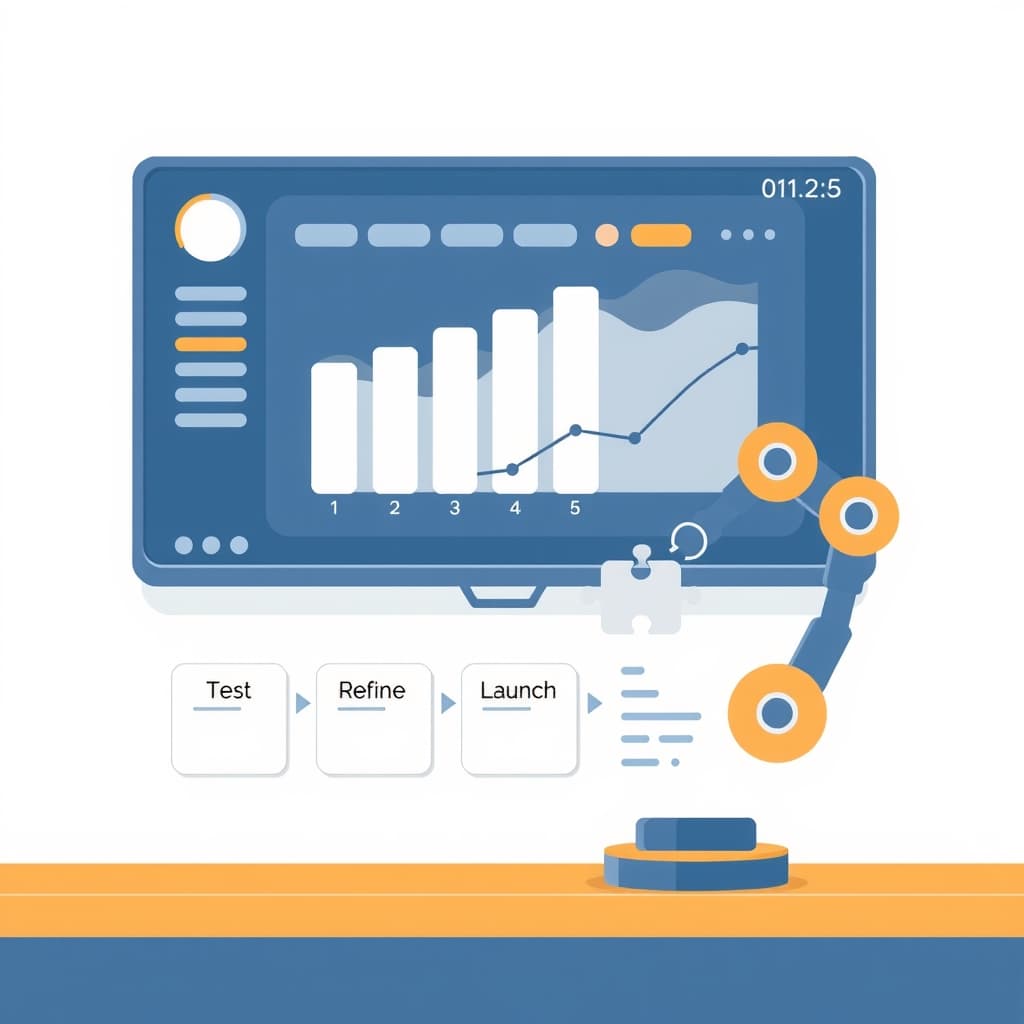
When you set out to choose the right LLM for a new product feature, you’re not just picking a model—you’re defining the user experience, the engineering budget, and the long‑term risk profile of your SaaS offering. A misaligned choice can inflate latency, drive up costs, or expose customers to hallucinations that erode trust. This guide walks growth‑stage founders, product leaders, and ops managers through the practical steps needed to align model capabilities with business outcomes.
Why LLM selection matters for user‑facing AI features
Customer‑facing AI is a direct brand touchpoint. If the model is slow, responses feel clunky and users abandon the workflow. If it generates inaccurate or fabricated content, the perceived reliability of your entire platform drops. Moreover, regulatory environments in Europe and Turkey increasingly scrutinize AI outputs, making compliance a factor in model choice. Selecting an LLM that balances speed, factuality, and data privacy protects both your revenue funnel and your reputation. For founders who are still validating scope, see our MVP Scope Validation Checklist for a framework that integrates AI risk assessment early in the product discovery phase.
Defining the problem: task type, latency, and data constraints
Start by classifying the AI task: is it classification, summarization, generation, or a hybrid? Each class has different latency expectations. A real‑time chat assistant must return a reply within 200 ms, while a nightly report generator can tolerate several seconds. Data constraints also matter: do you need to keep prompts on‑premise for privacy, or can you send them to a cloud provider? Identify the maximum token length your use case requires, and whether you need to fine‑tune on proprietary data. Mapping these dimensions—task type, latency budget, and data residency—creates a decision matrix that narrows the candidate pool before you even look at pricing.
Evaluating model capabilities: accuracy vs. hallucination risk
Model size correlates with raw language ability, but larger models also tend to hallucinate more when prompted ambiguously. Conduct a quick benchmark: feed a representative sample of real user queries and score outputs on factual correctness, relevance, and tone. Use a binary rubric (accurate / inaccurate) and calculate a simple accuracy rate. Pair this with a qualitative assessment of hallucination severity—does the model produce plausible‑but‑wrong statements, or does it outright fabricate data? For high‑stakes B2B workflows, prioritize models with documented lower hallucination rates, even if they sacrifice a few percentage points of fluency.
Cost modeling: token pricing, throughput, and budgeting tips
LLM providers charge per 1,000 tokens for input and output. Multiply the average tokens per request by your projected daily request volume to estimate raw usage. Then factor in peak throughput: can the model sustain your burst traffic without throttling? Add a safety margin of 20 % to cover growth spikes. For budgeting, break costs into three buckets—baseline usage, peak buffer, and contingency. Compare providers not only on per‑token price but also on volume discounts and enterprise licensing options. Remember that hidden costs—such as additional storage for fine‑tuning data or higher‑tier support—can erode the cheapest headline rate.
Small vs. frontier models: when each makes sense
Small, open‑source models (e.g., LLaMA‑7B) excel when you need full control, on‑premise deployment, or tight cost constraints. They are ideal for internal tools, data‑sensitive workflows, or when you have a dedicated ML ops team. Frontier models (e.g., GPT‑4, Claude) shine for complex generation, nuanced language understanding, and rapid time‑to‑market because they require no fine‑tuning. Choose a small model if your latency budget is sub‑100 ms and you can tolerate a modest drop in linguistic richness. Opt for a frontier model when the feature is a competitive differentiator and you need state‑of‑the‑art performance, even if it means higher per‑token spend.
Testing methodology: rapid prototyping and A/B evaluation
Build a minimal integration layer that can swap model endpoints with a configuration flag. Run a two‑week pilot where half of your users see responses from Model A and the other half from Model B. Track key metrics: response time, task completion rate, and user satisfaction (via NPS or a simple thumbs‑up/down). Use statistical significance testing (e.g., chi‑square for binary outcomes) to decide if the observed lift justifies the cost differential. Rapid prototyping combined with data‑driven A/B results lets you iterate quickly without committing to a full rollout.
Operational considerations: monitoring, versioning, and fallback strategies
Once the model is in production, set up real‑time monitoring for latency, error rates, and hallucination spikes. Log prompt‑response pairs in a secure, queryable store to enable post‑mortem analysis. Adopt semantic versioning for model upgrades: label each deployment as v1.0, v1.1, etc., and keep the previous version warm for a rollback window. Implement a fallback path—such as a rule‑based engine or a smaller, cheaper model—to serve requests when the primary LLM exceeds latency thresholds or encounters an outage. These practices keep the feature resilient and maintain user trust.
Integrating the chosen LLM without a full rewrite
Leverage a thin abstraction layer that isolates LLM calls behind a service interface. In a Next.js codebase, this can be a server‑side API route that forwards requests to the selected provider. Because the rest of your application talks to the abstraction, swapping providers or adding a caching layer requires only changes inside that route. This approach aligns with our full‑stack development services philosophy: deliver new capabilities while preserving existing architecture, minimizing disruption to ongoing feature work.
Conclusion & next steps: building a decision framework and CTA
Choosing the right LLM is a multi‑dimensional decision that blends product goals, technical constraints, and financial realities. Start with a problem definition matrix, run quick benchmarks, model costs, and validate with A/B testing. Cement the process in a decision framework that includes monitoring and fallback plans, then embed the model behind a clean service layer to avoid massive rewrites. Ready to accelerate your AI feature roadmap with a partner who can prototype, integrate, and support at scale? Book a call with SiteFusion today and turn your LLM strategy into a competitive advantage.